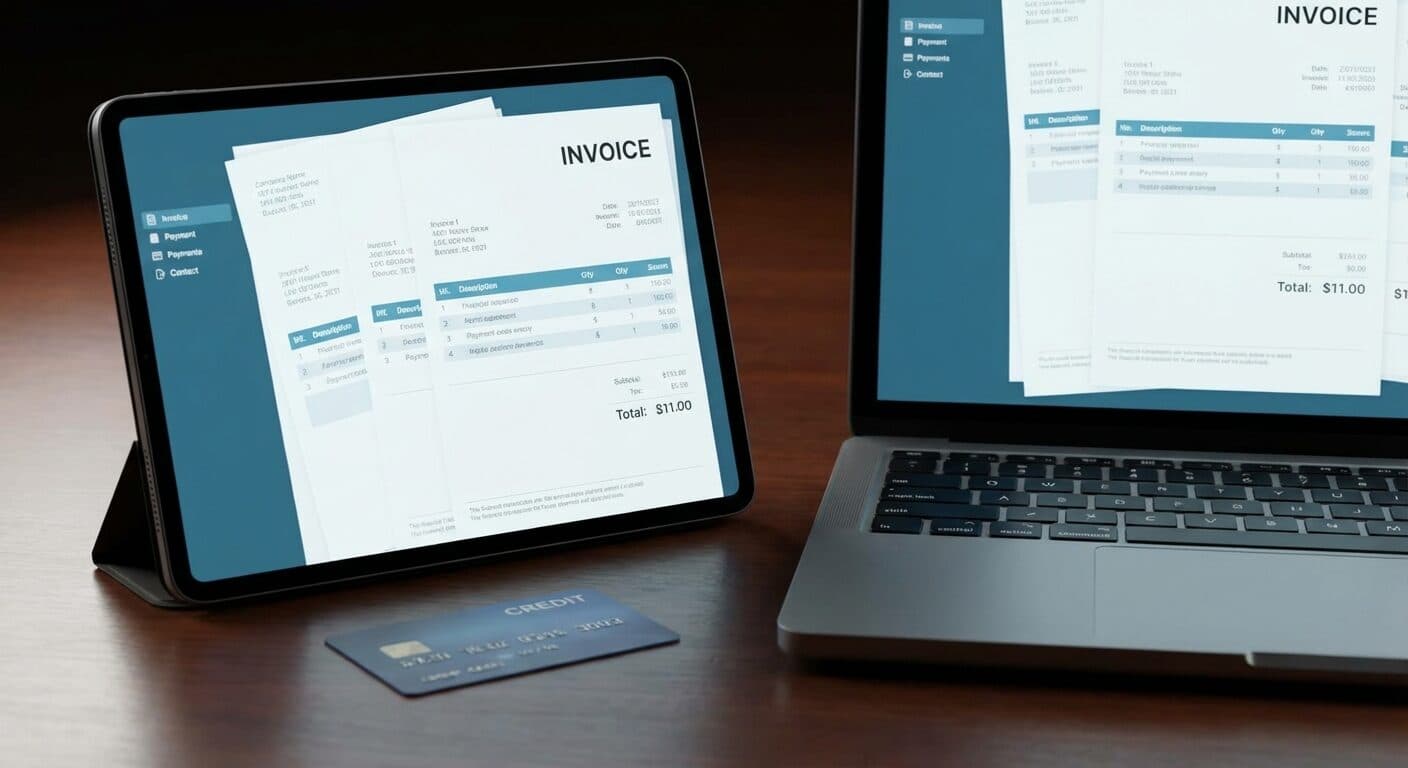
Invoicing - Context Studios AI Solutions

Invoicing

From contract signature to cash in bank—fully automated. AI reads contracts, generates invoices, predicts payment timing, and chases late payers so you don't have to

Challenges We Solve

  • Are you suffering from late payment receipts?
  • Does manual invoice creation take too much time?
  • Is it difficult to keep track of outstanding receivables?
MVP in 4 weeks
Fast delivery
Full source code
You own everything
14+ days support
After go-live

Possible Solution Approaches

The following solution examples illustrate how digital tools can optimize specific business processes and workflows. Context Studios supports you in developing the right digital solution for your use case.

The following examples serve as inspiration and show the spectrum of possible digital solutions. Each project is individually tailored to your requirements and budget.

Why This Solution is Crucial

Professional invoicing is the backbone of healthy cash flows. Studies show: 46% of all invoices are paid late – main reasons are unprofessional invoices, missing payment options, and no payment reminders. Automated invoicing systems solve these problems: they generate correct, legally compliant invoices in seconds, send automatic payment reminders, and offer multiple payment options (bank transfer, credit card, PayPal). The business impact: reduced days sales outstanding (DSO) from 45 to 25 days massively improves liquidity. Time savings: 85% less effort for invoice creation and tracking means more time for core business. Error reduction: automatic calculation and validation prevents embarrassing mistakes. Additionally, digital invoices enable better analytics: which customers pay on time? Which services are most profitable? Which payment terms optimize cash flow?

Market & Trends

The invoicing market is undergoing a digitalization wave. E-invoicing is already mandatory in many EU countries (B2G) and is increasingly becoming B2B standard. Germany: from 2025, gradual e-invoice obligation for B2B transactions. Technology landscape: (1) Standard tools (Lexoffice, sevDesk, FastBill) for SMEs – cheap, fast, but limited customization. (2) Enterprise ERPs (SAP, Microsoft Dynamics) with invoicing modules for large companies. (3) Custom solutions for special requirements (complex pricing models, multi-entity consolidation). Trends: (1) Embedded finance – invoices with integrated payment links (Stripe, Mollie) enable 1-click payment. (2) Subscription billing – recurring invoices for SaaS and service businesses with automatic retry on payment failures. (3) Multi-currency & tax compliance – international business requires automatic currency conversion and tax calculation. (4) AI-powered invoice processing – OCR for automatic reading of incoming invoices, smart matching with purchase orders.

Common Challenges

  • Are you suffering from late payment receipts?
  • Does manual invoice creation take too much time?
  • Is it difficult to keep track of outstanding receivables?

A professional digital solution addresses these challenges through automation, centralization, and intelligent processes.

Example Features

Professional invoice creation in seconds
Automatic payment tracking and reminders
Automatically create recurring invoices
Expense management and expense reports
Automatic tax calculation and VAT
Multi-currency support with exchange rates
Benefits

What You Gain

Discover the benefits of our solution for your business

1

Faster payment receipts through automated processes

2

Fewer errors in invoices and finances

3

Better overview of your finances

Choose Your Implementation Path

Three proven paths to success - tailored to your requirements

Consultation & Selection

Day 1-2

Requirements analysis and selection of the right SaaS tools

Needs AnalysisTool RecommendationCost-Benefit Analysis

Setup & Configuration

Day 3-7

Setting up and customizing SaaS platforms for your needs

Account SetupWorkflow ConfigurationAutomation Setup

Launch & Training

Day 8-14

Go-live, team training and handoff with documentation

Go-LiveTeam TrainingSupport Documentation
Our Development Expertise

How Context Studios Develops Your Solution

Three proven paths - tailored to your requirements

Proven SaaS Tools

HubSpot, Notion, Airtable, Make & more

Custom Configuration

Tailored to your processes

Workflow Automation

Reduce manual work by 80%

Quick Start

Ready in 1-2 weeks

No Development Risk

Proven tools instead of custom code

Training & Support

Your team gets trained and supported

You might also be interested in

Discover related topics and solutions for your requirements

Frequently Asked Questions

Answers to the most important questions about implementation

Our AI analyzes your historical invoices, payment terms, customer payment behavior, and accounting categories. It learns your naming conventions, tax rules, and billing cycles to automate invoice creation accurately.

Always. AI creates draft invoices that require your approval before sending. You can set confidence thresholds—high-confidence invoices can auto-send while edge cases queue for review.

Financial data security is paramount. AI processing happens in isolated, encrypted environments. Your data never trains shared models, and we maintain SOC 2 compliance with full audit trails for all AI-assisted actions.

Invoices in Germany must contain mandatory information according to §14 UStG: (1) Full name and address of service provider. (2) Full name and address of service recipient. (3) Tax number or VAT ID. (4) Invoice date. (5) Consecutive, unique invoice number. (6) Quantity and type of service. (7) Date of delivery/service. (8) Remuneration and tax amount or reference to tax exemption. (9) Reference to retention obligation for construction services. Additionally: for reverse-charge procedure (B2B EU): reference "tax liability of service recipient". Small businesses (§19 UStG): reference "no tax shown due to small business regulation". E-invoices: from 2025, B2B invoices must be able to be sent in structured format (XRechnung, ZUGFeRD). Software requirement: GoBD-compliant (immutable archiving for 10 years). Non-compliance leads to: non-deductibility of input tax for customer, fines during audits.

Recurring billing is essential for subscription businesses. Setup: (1) Template definition: create invoice templates with fixed line items (e.g., "Monthly SEO retainer - €2,000"). (2) Billing schedule: define intervals (monthly, quarterly, annually) and start date. (3) Automatic generation: system creates invoices automatically on billing date. (4) Auto-send: invoices are sent via email (optional: only after manual review). (5) Payment collection: with payment provider integration (Stripe, GoCardless): automatic collection via SEPA/credit card. On failure: retry logic (3 attempts) and automatic notification. Advanced: (1) Proration: for mid-cycle changes (upgrade, downgrade) proportional calculation. (2) Usage-based billing: combination of flat fee + variable component (e.g., API calls). (3) Multi-currency: billing in customer currency with exchange rate snapshot on billing date. Tools: Stripe Billing, Chargebee, or custom integration. Important: transparent communication – customers should receive advance notice 3-5 days before debit.

Embedded payments accelerate payment receipts by 40-60%. Implementation: (1) Payment provider selection: Stripe (international, developer-friendly), Mollie (EU-focus, local methods), PayPal (high adoption, but higher fees). (2) Payment link generation: each invoice gets unique payment link. Customer clicks, chooses payment method, pays – status is automatically updated in your system. (3) Payment methods: offer at least 3 options – credit card (Visa, Mastercard), SEPA direct debit (for B2B), PayPal (consumer). Optional: Klarna, Apple/Google Pay. (4) Security: PCI-DSS compliance via provider (you never store card data), 3D-Secure for EU transactions. (5) Reconciliation: automatic matching of payment receipts with open invoices via reference ID. (6) Fees: typically 1.5-2.9% + €0.25 per transaction – calculate these in or pass them on (surcharging, regulated). Technical setup: REST API of provider, webhook for payment status updates. B2B consideration: many B2B customers prefer classic bank transfer – don't force online payment, offer it as option.

Have more questions? Contact us for personal consultation.

Ready for Invoicing?

Let's start your digital transformation together

30 minutes free initial consultation • No obligations